
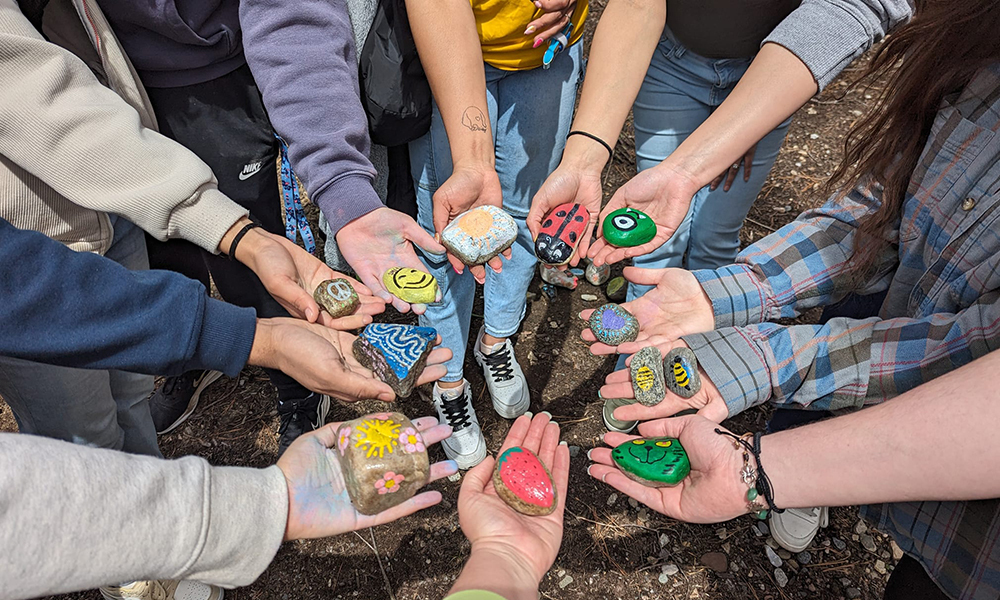
Western New England University’s Honors Program is celebrating a distinctive achievement following the publication of an article in Honors in Practice, a national academic journal produced annually by the National Honors Council. The publication highlights WNE’s Meditation Garden Project and marks a significant milestone for the University, as two Honors students served as co-authors alongside Professor of Philosophy and Honors faculty member Heather Salazar, Ph.D.
Honors in Practice reaches thousands of faculty, administrators, and scholars in Honors programs across the country. Undergraduate students are seldom featured, making the inclusion of WNE student voices especially noteworthy. Co-authors Kaitlyn Parisan ’26 and recent alumna Lydia Barrett-Miller ’24 collaborated with Salazar over a two-year research and writing process.
The published article traces the origin and evolution of the student-built Meditation Garden, which began as an Honors philosophy project and has since become a campus space that blends mindfulness, well-being, and student-driven leadership. According to the published abstract, the project demonstrates how “students collaborated to enhance the space and host popular mindfulness events for the student body,” and explains how “the meditation garden encourages students’ health and well-being” and helps Honors students “gain powerful skills in transformational leadership and collaboration.”
The authors further argue that the project’s impact extended beyond aesthetics and physical space. As stated in the journal, “There are three major benefits of the Meditation Garden Project: (1) The meditation garden itself provides the student body with a place to de-stress; (2) Events hosted in the garden create a positive and inclusive community on campus; and (3) The class project gives honors students a way to develop leadership skills, creativity, and social awareness.”
For Barrett-Miller, who graduated in 2024, the project shaped her academic growth. “The Meditation Garden Project had a powerful impact on me during my undergraduate experience,” she wrote. “I learned a lot about effective communication and creating action plans for projects that can turn into so much more… The meditation garden is a place I wander on campus to practice mindfulness and reflect on my time at Western New England University.”
Parisan, a current Honors student, reflected on leadership through empowerment. “The Meditation Garden Project showed me that leadership is less about directing and more about empowering and encouraging others to speak their minds,” she wrote. “We did not just build a garden – we built a community.”
The journal article also documents how the project emerged at a pivotal moment for student well-being as the campus navigated the return from COVID-19 disruptions. Salazar described the backdrop in the publication: “COVID-19 affected our university greatly… I wanted to integrate into my curriculum something that would aid student mental health.”
Beyond publication, the project now plays an inspirational role for future Honors students. Beginning this year, incoming cohorts will read the article in their initial Honors coursework, allowing them to see firsthand how student initiative can result in tangible and lasting academic contributions.
Speaking in her capacity as Honors faculty leadership, Salazar highlighted the significance for student scholarship and belonging: “One of the most important parts of the Honors experience is helping students realize the scope of what they are capable of. This project shows that our undergraduates can contribute meaningfully to national academic conversations while strengthening well-being and community on campus.”
As she concluded in the published article, “Doing this project with them each semester gives me a feeling of being an important part of a greater whole.”