In Massachusetts, Black mothers experience severe maternal health complications at more than twice the rate of White mothers — a stark disparity that reflects broader inequities in access, treatment, and trust across the health care system. Against this backdrop, Western New England University School of Law hosted a sold-out forum examining racial disparities in health care, bringing together legal scholars, physicians, and public health leaders to explore how inequities shape care across the lifespan.
Against this backdrop, the Western New England University School of Law convened a sold-out forum centered on racial inequities in health care, bringing together legal scholars, clinicians, and public health leaders for a wide-ranging discussion on disparities and solutions.
Keynote Highlights Public Health Policy Innovations
Pareesa Charmchi Goodwin, Executive Director of the Commission on Racial Equity in Public Health for the Connecticut General Assembly, delivered the keynote address. Goodwin framed the conversation around systemic drivers of health disparities and the public policy responses needed to address them. She discussed her work confronting entrenched inequities in health access and outcomes in Connecticut, including environmental justice concerns such as the siting of polluting industries in low-income neighborhoods. She also shared insights into a pioneering initiative to include Racial and Ethnic Impact Statements on all pending Connecticut legislation — a tool designed to help lawmakers anticipate and mitigate potential impacts on disparities much as they already assess fiscal consequences. The audience of more than 70 students, faculty, and community members responded enthusiastically to her call for cross-sector collaboration to advance health equity.
Interdisciplinary Panel Explores Disparities Across the Lifespan
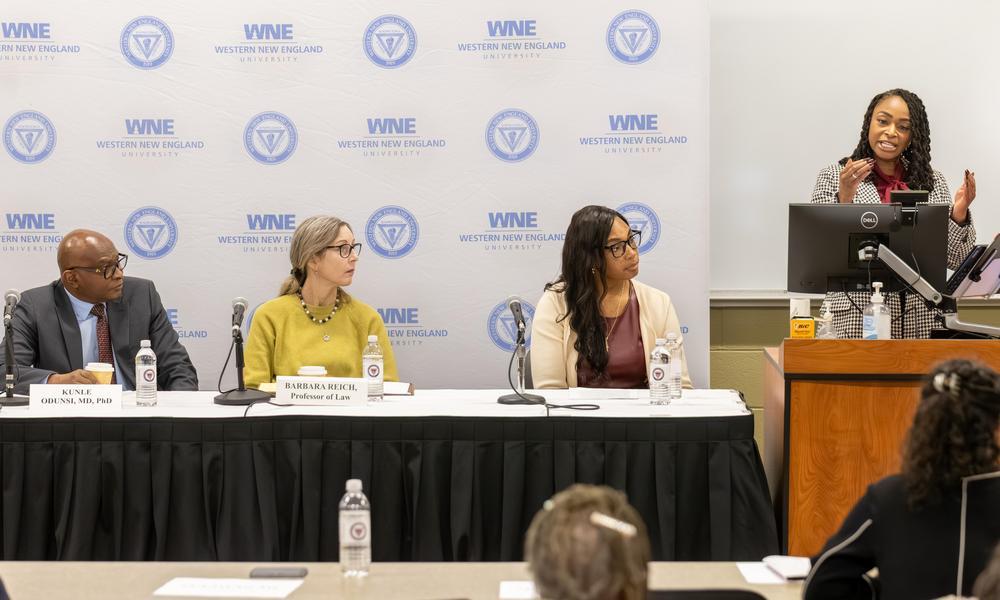
Following the keynote, Professor Tolu Odunsi-Nelson, associate professor of Law, moderated a panel discussion that explored how racial disparities manifest at different stages of life.
- Dr. Tosin Odunsi, an obstetrician-gynecologist and sister to Prof. Odunsi-Nelson, opened the panel with a presentation on racial disparities in maternal health care. Drawing on research and clinical experience, she highlighted gaps in care that disproportionately affect women of color and emphasized the importance of culturally responsive care and community engagement.
- Dr. Kunle Odunsi, a gynecological oncologist and cancer researcher, offered an update on cancer outcomes. He underscored that while overall cancer mortality rates have declined, disparities in treatment outcomes persist, with patients of color experiencing less favorable prognoses and access to cutting-edge therapies.
- Professor Barbara Reich, who teaches torts and health law at WNE, concluded the panel by examining racial disparities in end-of-life care. She noted research showing that people of color are more likely to receive aggressive interventions that do not meaningfully extend life — a pattern linked to poor communication, mistrust of the medical system, and gaps in advance care planning.
Community Engagement and Collaborative Sponsorship
The event drew strong participation from both the University and the greater Springfield community. Sponsors included the WNE Law Outreach and Diversity Committee, the Black Law Student Association, the Women’s Law Association, Parents Attending Law School, the Reproductive Law Association, and the Springfield Alumnae Chapter of Delta Sigma Theta.
By convening experts from law, medicine, and public policy, Western New England University continues to foster interdisciplinary dialogue and equip future legal professionals with the insight to engage thoughtfully with complex social justice issues shaping health and equity in the region.