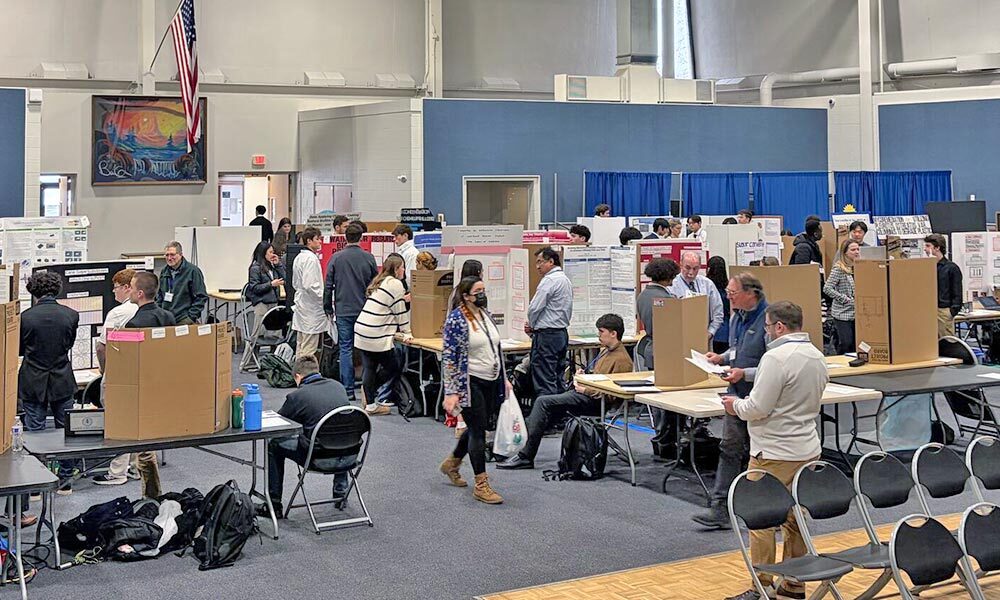
Western New England University welcomed some of the region’s most promising young scientists and engineers when it hosted the Region 1 Massachusetts Science and Engineering Fair (MSEF) on Friday, March 7, 2025.
The annual event brought high school students from across western Massachusetts to campus to present original, student-led research and compete in a wide range of STEM disciplines—from engineering and computer science to biology, chemistry, and environmental science.
Each year, thousands of students across Massachusetts put their creativity and problem-solving skills to the test through science fairs at the school, district, and regional levels. The top projects advance to the statewide Massachusetts Science & Engineering Fair—an iconic annual showcase of student ingenuity that has been celebrating young minds since 1949. Together, these events highlight the power of independent, student-driven STEM research.
For many participants, the experience marked their first visit to Western New England University and provided an opportunity to engage directly with faculty, staff, and professionals in STEM fields.
“This was an excellent opportunity to showcase Western New England University to regional high school students,” noted Professor Christian Salmon, PhD, PMP, CSP, Department Chair of Industrial Engineering and Engineering Management. “For many, this may have been their first impression of WNE as a possible choice for college.”
A Hands-On Judging Experience
Faculty and staff from across campus served as volunteer judges, helping evaluate student projects and mentor the next generation of innovators.
Judges were assigned three to six projects interviewing students about their research, evaluating scientific methods and findings, and submitting scores and feedback before departing.
The judging session took place from approximately 9:00 a.m. to 12:00 p.m., with about 40 judges from the WNE community participating across disciplines.
Serving as a judge provided a meaningful opportunity to support students at a pivotal moment in their academic journey. For many participants, presenting their work to STEM professionals was a milestone experience—building confidence, offering encouragement, and expanding their sense of what’s possible in science and engineering fields.
Showcasing the Breadth of STEM
Student projects spanned a wide array of scientific and engineering fields, including:
• Astronomy and Space Science
• Behavioral and Social Sciences
• Biochemistry
• Biology (Cellular, Molecular, Microbiology; Evolution, Plant & Animal Science)
• Chemistry
• Computer Science and Technology
• Earth and Environmental Science
• Engineering (Biomedical, Electrical, Mechanical, Environmental)
• Physics
Building Connections and Inspiring Futures
Hosting the Region 1 MSEF reflected Western New England University’s commitment to hands-on learning, STEM education, and community engagement. The event not only highlighted the creativity and rigor of high school research but also introduced students to the University’s academic environment—reinforcing WNE’s role in shaping the next generation of innovators.