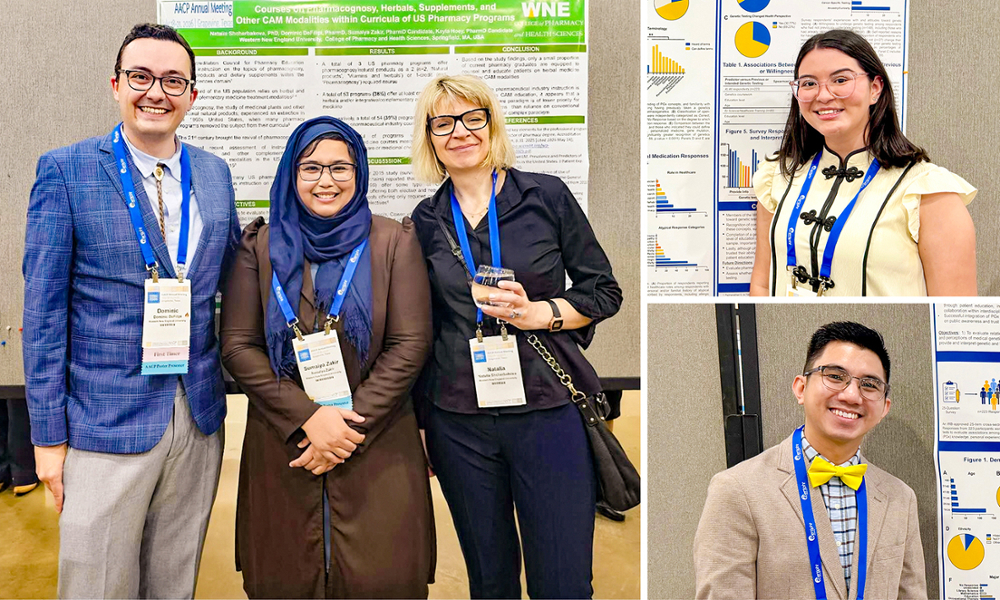
Three Western New England University College of Pharmacy and Health Sciences student researchers shared their work on the national stage this summer, presenting original research at the 2026 American Association of Colleges of Pharmacy (AACP) Annual Meeting in Grapevine, Texas. The annual conference is one of the country's leading gatherings for pharmacy educators, researchers, and student scholars.
Doctor of Pharmacy candidate Sumaiya Zakir, along with student pharmacists Yanixa Quiñones-Avilés and Cecil James Buguis, presented research projects addressing important topics in pharmacy education, complementary medicine, and pharmacogenomics.
Examining Complementary and Alternative Medicine Education
Zakir presented her poster, “Courses on Pharmacognosy, Herbals, Supplements, and Other Complementary and Alternative Medicine (CAM) Modalities within Curricula of U.S. Pharmacy Programs.” Conducted under the guidance of Associate Professor Dr. Natalia Shcherbakova, with co-authors Dr. Dominic DeFilipi and Kayla Hoey, the study evaluated how frequently accredited U.S. colleges of pharmacy provide formal instruction on pharmacognosy, herbal medicines, dietary supplements, and other complementary and alternative medicine topics.
The research involved reviewing the websites and course catalogs of accredited pharmacy programs nationwide to identify courses related to pharmacognosy, CAM, and pharmaceutical industry education. The study found that despite the requirement of the Accreditation Council for Pharmacy Education, less than half of the US pharmacy programs (38%) address topics of complementary and alternative medicine including herbal products and dietary supplements in sufficient depth via required or elective curriculum. Surprisingly, pharmaceutical industry-focused coursework is offered just as often (39% ) despite not falling under accreditation-required content.
The findings highlight opportunities to strengthen pharmacy curricula and better prepare future pharmacists to counsel patients on the safe and effective use of herbal medicines and dietary supplements.
For Zakir, who holds a Bachelor of Science degree in Anatomy, the experience aligned closely with her interests in research, patient care, and pharmacy education.
"My background in anatomy and my PharmD education have shown me how important it is for healthcare professionals to understand both conventional medications and complementary therapies," Zakir said. "As pharmacists, we need to be prepared to provide evidence-based counseling on herbal medicines, dietary supplements, and potential drug-herb interactions so that patients can make informed decisions."
Presenting at AACP also provided an opportunity to engage with pharmacy educators and researchers from across the country while strengthening her research and presentation skills.
"I am sincerely grateful to Dr. Natalia Shcherbakova for giving me this opportunity and for her outstanding guidance throughout this project," Zakir said. "I am also thankful to Dr. Dominic DeFilipi for his mentorship and to my co-author, Kayla Hoey, for her collaboration. This experience has inspired me to continue pursuing research that advances pharmacy education and ultimately improves patient care."
Exploring Knowledge and Perceptions of Genetics and Pharmacogenomics
Quiñones-Avilés and Buguis presented their research titled, “Demographics, Level of Education, Experience with Genetic Testing, and Genetics and Pharmacogenomics Knowledge and Perceptions.” The project was conducted in collaboration with Vivian Shi, Irina Zivin, and faculty mentor Dr. Shannon Kinney.
The study examined how demographic characteristics, educational background, and personal experiences with genetic testing influence knowledge and perceptions of genetics and pharmacogenomics. Survey results showed that participants generally held positive attitudes toward genetic testing and demonstrated familiarity with genetics concepts despite having limited formal education in the field.
The researchers also identified an important opportunity to increase public awareness of pharmacists' expertise in interpreting and applying pharmacogenomic information. As precision medicine continues to expand, pharmacists are increasingly positioned to help patients and healthcare providers understand how genetic differences can affect medication response.
The findings underscore the growing importance of pharmacogenomics in healthcare and support future efforts to improve education and literacy related to genetics and precision medicine among both patients and healthcare professionals.
Advancing Scholarship and Professional Development
Participation in the AACP Annual Meeting provided all three students with valuable opportunities to share their research, collaborate with peers and faculty from institutions across the country, and contribute to ongoing conversations shaping the future of pharmacy education and practice.