For many families, a home represents more than a place to live. It is a source of stability, a financial asset, and a legacy intended to be passed from one generation to the next. Yet for thousands of families across the country, legal complications surrounding inherited property can put those goals at risk.
To explore solutions to this challenge, Western New England University School of Law recently convened housing leaders, legal professionals, policymakers, and community advocates for Untangling Titles: Preserving Homeownership and Generational Wealth in Underserved Communities.
The conference focused on heirs' property, a form of ownership that arises when property is passed down without a clear transfer of title. While often overlooked, these legal complications can make it difficult for families to retain inherited homes, access financing, make improvements, or transfer property to future generations. The issue can also contribute to neighborhood vacancy, housing instability, and the loss of generational wealth.
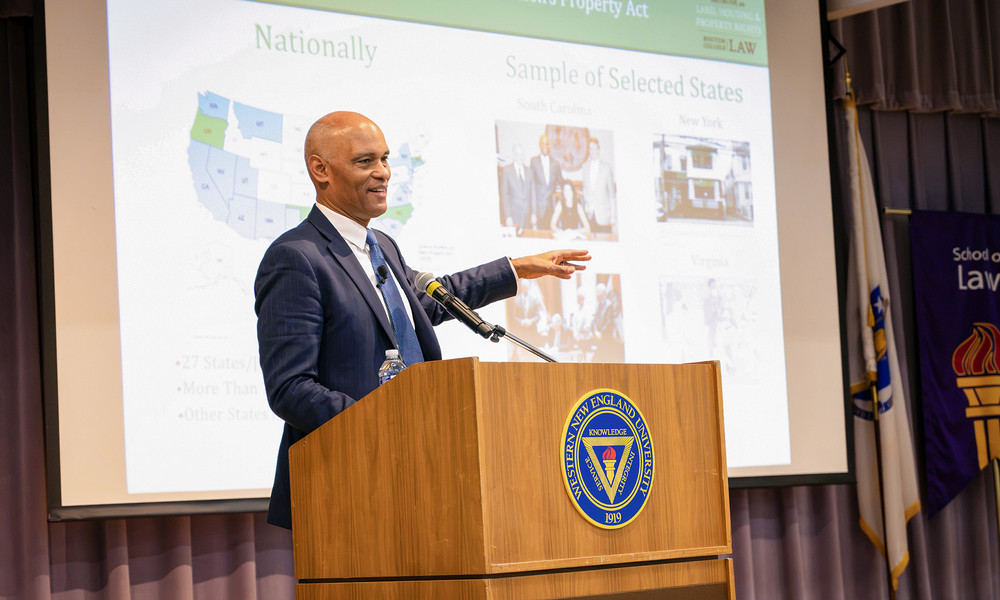
The conference's keynote speaker, Thomas Mitchell, MacArthur Fellow and founding director of the Initiative on Land, Housing, and Property Rights at Boston College Law School, shared insights from decades of work advancing legal reforms that help families retain inherited property and preserve generational wealth.
The event aligned with the School of Law's ongoing commitment to addressing issues that affect economic opportunity and community well being.
"Homeownership remains one of the most important pathways to economic stability and generational wealth," said Zelda Harris, dean of Western New England University School of Law. "The law school is committed to advancing solutions to economic inequality through its programs, clinics, and faculty scholarship. This conference brings together experts and practitioners from across the country to discuss practical solutions that can help families preserve assets, which in turn strengthen communities."
The gathering brought together voices from across the legal, housing, nonprofit, and public sectors to examine how policy, legal services, and community partnerships can help families navigate title issues and maintain ownership of inherited property.
For communities like Springfield, resolving these issues can strengthen neighborhoods and support broader revitalization efforts.
"The tangled titles that often result from heirs' property impact the housing stock in cities like Springfield, contributing to vacancy and complicating neighborhood revitalization efforts," said Dina Fein, retired judge of the Western Division Housing Court and former interim director of the law school’s Center of Social Justice. "We hope the conference will catalyze conversations and planning in the local legal community, so that heirs can get timely and effective estate planning and probate assistance to preserve their family homes in a way that allows neighborhoods to thrive as well."
The event reflected the School of Law's commitment to advancing solutions-oriented conversations that connect legal scholarships with real world challenges. By bringing together leaders from law, housing, government, and community organizations, Western New England University fostered dialogue focused on preserving family assets, strengthening neighborhoods, and expanding pathways to economic opportunity.