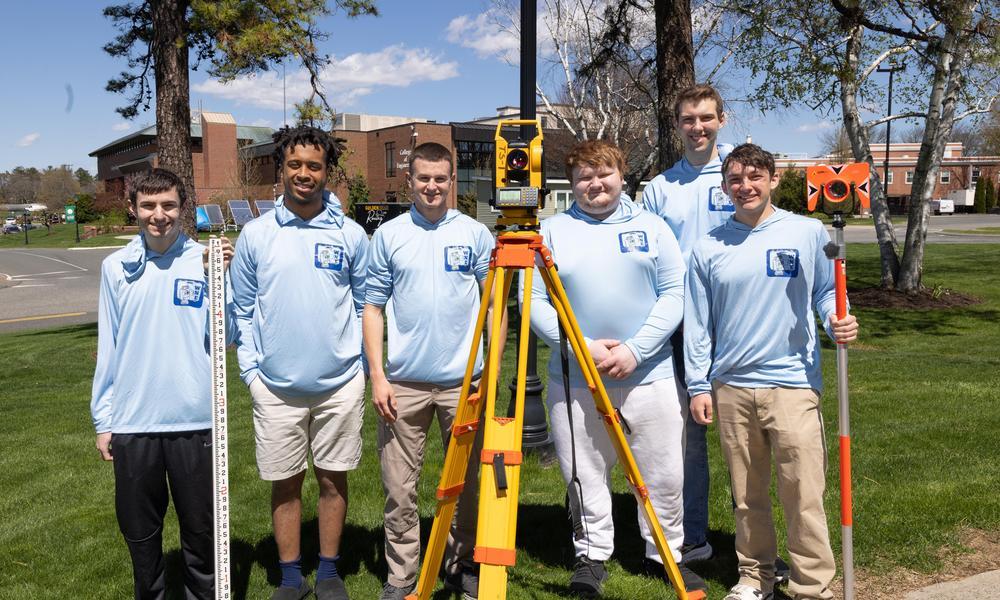
Western New England University’s Civil Engineering Surveying Team has once again earned top honors, capturing First Place at the American Society of Civil Engineers (ASCE) Regional Competition for the second consecutive year. With the victory, the team advances to the 2026 ASCE UESI Surveying Society-wide Finals Competition, scheduled for June 25–27 in Fairmont, West Virginia.
The award-winning team includes students from the College of Engineering:
-
John Dafonseca (Civil Engineering)
-
Sean Ebanks (Construction Management)
-
Jacob Lyons (Captain, Civil Engineering)
-
Michael Mason (Civil Engineering)
-
Henry Ryczek (Civil Engineering)
-
Julien St. Jean (Civil Engineering)
The team was guided by faculty advisor Frank Blachly, whose extensive experience as a railroad engineer and commitment to hands-on teaching have played a key role in student success.
“This achievement reflects the team’s exceptional technical ability, attention to detail, and professionalism,” said Blachly. “They demonstrated what it means to apply classroom knowledge in real-world conditions.”
DONATE NOW: To help our students represent WNE at the national level, we need your help. We invite you to help us make this tremendous opportunity possible for these deserving students. Our team is seeking to raise $8,000 to support travel and participation expenses for the national competition.
A Competition Rooted in Real-World Engineering
The ASCE UESI Surveying Competition highlights the critical role surveying plays across the full civil engineering project lifecycle—from design through construction and long-term operation.
The competition includes both office and field components designed to mirror real-world challenges. Weeks before the event, teams were given a dataset of more than 12,000 survey points and tasked with developing a detailed site drawing. On the eve of the competition, WNE students John Dafonseca and Sean Ebanks presented their completed plans to a panel of four professional surveyors for evaluation.
In the field competition, the six-member team was tested across four timed events, with each student participating in no more than three tasks—requiring both technical skill and strategic coordination.
Precision Under Pressure
In the differential leveling challenge, Jacob Lyons, Sean Ebanks, and Henry Ryczek used a level and rod to determine the elevation of a point not visible from a known benchmark. Over a distance of roughly one-third of a mile, the team closed their level run with an error of just 1/16 of an inch.
The pacing event pushed students to rely on instinct and experience alone. Without instruments, John Dafonseca, Julien St. Jean, and Michael Mason measured three sides of a triangle across wooded terrain and a creek. Their result was within inches of the judges’ measured distance of approximately 1,000 feet.
To determine the elevation of an inaccessible point—a metal band on the roof of a multi-story building—Sean Ebanks conducted field measurements while Henry Ryczek and teammates performed calculations. Their final answer differed from the judges’ by just one inch.
In the sewer stakeout challenge, the team calculated how deep a contractor would need to dig to install a pipe, using provided elevations and field measurements taken at 50-foot intervals. Their results matched the judges’ values at every location.
Beyond accuracy, the team also demonstrated efficiency. Although each task was allotted 90 minutes, WNE completed all fieldwork in just over two hours total—well ahead of schedule.
During the competition, one professional judge summed up the team’s performance: “I am going to hire this team.”
Why Surveying Matters
Surveying is foundational to successful civil engineering and construction projects. From laying out roadways to establishing elevations for utilities, precision in measurement ensures infrastructure is built safely, efficiently, and in the correct location.
High-quality surveying reduces costly errors, minimizes delays, and serves as a critical link between engineering design and construction execution—an area where WNE students continue to excel.
Supporting the Journey to Nationals
As the team prepares to represent Western New England University on the national stage, they are working to raise approximately $8,000 to support travel and competition expenses.
Support from the University community and partners will help provide these students with the opportunity to compete at the highest level and showcase their skills on a national platform.
A Tradition of Excellence
This back-to-back regional victory underscores the strength of Western New England University’s hands-on, experiential approach to engineering education—where students don’t just learn concepts, but apply them in meaningful, real-world contexts.
“I am proud of these students,” said Blachly. “They proved that the survey education they are receiving at WNE exceeds that of other regional schools.”
The University community celebrates the team’s accomplishment and looks forward to cheering them on at nationals this June.