What exactly is Web3, and what role will artificial intelligence play in the future of work?
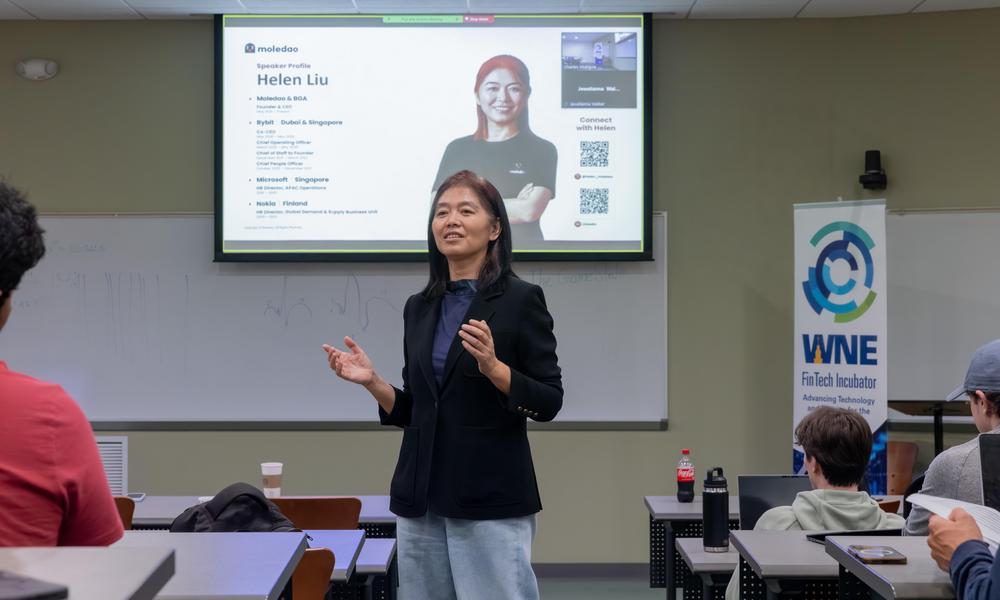
Those were among the questions explored during a recent fireside chat hosted by Western New England University's FinTech & AI Incubator featuring Helen Liu, former co-CEO of cryptocurrency exchange Bybit and founder of the Web3 talent development platform Moledao.
Organized by College of Business faculty members Charles Mutigwe and Ethan Jiang, the event attracted approximately 60 students from finance, engineering, business analytics, and mathematics programs, including several first-year students eager to learn more about emerging technologies and career opportunities in the rapidly evolving digital economy.
Liu's career has spanned global leadership roles in human resources and operations with companies including Nokia, Microsoft, and Lazada. She joined Bybit in 2020 as Head of Human Resources before advancing to Chief of Staff, Chief Operating Officer, and ultimately Co-CEO of one of the world's largest cryptocurrency exchanges by trading volume.
Recognizing that students arrived with varying levels of familiarity with Web3 technologies, Associate Professor of Finance Ethan Jiang opened the session with an overview of blockchain technology, cryptocurrency, and the global exchanges that enable digital asset trading. Liu then expanded on those concepts, sharing insights into the diverse career paths available within the industry and the skills employers increasingly seek.
She highlighted four areas that continue to see strong demand for talent: trading, product management, risk management, and technology development. While acknowledging that artificial intelligence is rapidly transforming the workforce, Liu emphasized that human expertise remains essential across industries.
"While AI is changing how work gets done, the impact is not as simple as replacing jobs," Liu explained. She noted that even roles often viewed as repetitive still require human judgment, oversight, and creativity. Instead, professionals who can effectively work alongside AI technologies will be best positioned for success.
Students embraced the opportunity to engage directly with an industry leader. Questions ranged from broad discussions about the future of cryptocurrency and decentralized technologies to practical concerns about career preparation.
One student asked whether programmers learning Python today should be concerned about AI replacing software developers in the future. Others explored where Liu sees the Web3 sector heading and how students can remain competitive in a technology-driven job market.
The conversation continued well beyond the formal session.
"The students and faculty asked thoughtful questions, and I was especially encouraged to see so many people stay afterward to continue the conversation," said Liu. "That level of curiosity and engagement made the session particularly meaningful for me as well."
Following her departure from Bybit earlier this year, Liu shifted her focus toward talent development, career coaching, and building opportunities within the Web3 ecosystem through Moledao. During her visit to campus, she also met with Paul Costanzo, dean of the College of Business, to discuss potential future collaborations involving workforce development and educational initiatives through WNE's FinTech & AI Incubator.
For Charles Mutigwe, associate professor of Business Analytics and Information Management and director of the FinTech & AI Incubator, the event exemplified the University's commitment to connecting students with leaders at the forefront of technological innovation.
"One of our goals is to give students direct access to practitioners who are helping shape emerging industries," Mutigwe said. "Conversations like these help students better understand not only where technology is headed, but also how they can prepare themselves to thrive in that future."
The fireside chat is part of the FinTech & AI Incubator's ongoing efforts to provide experiential learning opportunities, foster industry partnerships, and prepare students for careers at the intersection of finance, technology, and artificial intelligence. As emerging technologies continue to reshape the global economy, events like this help ensure WNE students gain valuable insight from professionals leading that transformation.